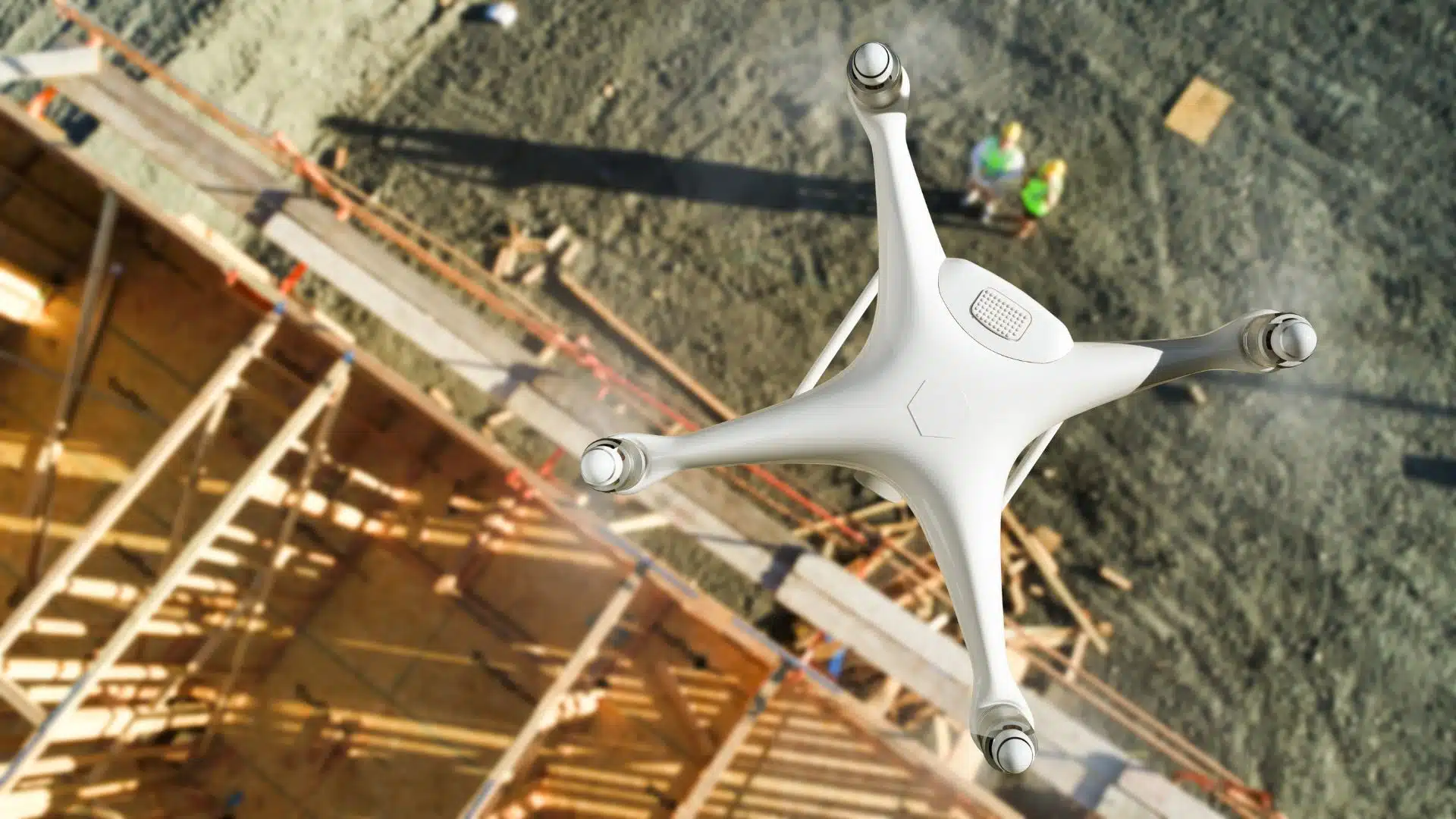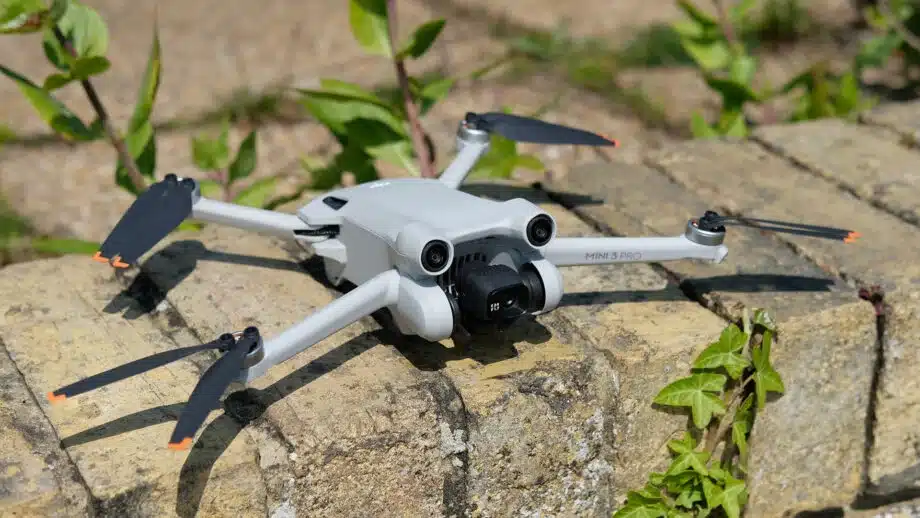
Commercial drones have become a standard surveying tool in the field of architecture, engineering, and construction in Australia. The construction industry in particular has historically been the fastest growing commercial adopter of drones ahead of mining and agriculture.
ABS innovation data highlighted that 39% of businesses in construction introduced a new or significantly improved operational process.
This impressive technology has developed rapidly in the last 5 years and can complete remarkable tasks when you consider how they cover hundreds of acres in a few hours, delivering accurate images and site information to the operator.
Drones have become extremely popular over the last decade and are a great alternative to more manual methods. In Australia, CASA or Civil Aviation Safety Authority is a government body responsible for the regulation, policy and surveillance of drone operations.
Table of Contents
All drone pilots and operators in Australia must comply with CASA’s drone rules and regulations. These rules lay down specific instructions to regulate the locations, altitude, flight distance and times of use to ensure safe and incident-free drone operation in Australian skies.
We’ve seen a fair share of drone crashes, damages, and on-site injuries, and over the last 8 years, having managed a business building and repairing drones. We believe drone safety should be a top focus for any drone operator, regardless of whether your activity is for recreational or commercial purposes. The last thing anyone wants is to damage your drone or cause injury or damage to other people or property, resulting in a potentially expensive and/or embarrassing situation. This is one of the main reasons why the CASA rules and regulations are in place – to reduce the risk of drone accidents.
There have been significant changes to CASA drone rules in recent years, and more are underway in 2025 and 2026. Let us look at what’s current and what’s coming, and how these changes impact drone operations in Australia.
General rules for flying drones in Australia
Flying drones is not rocket science. Having no prior flying experience you can be up and flying in a matter of minutes. However, in Australia, drone operators must have the proper training and certification to handle unexpected situations or events that can cause an accident.
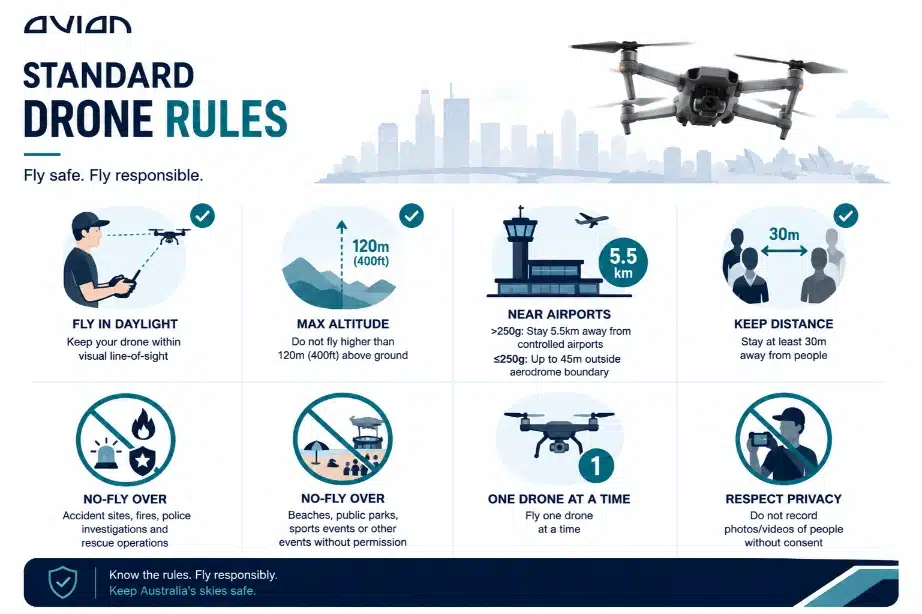
Before discussing the CASA drone rule updates, let us take a quick refresher on the drone safety rules, also known as the standard operating conditions:
- Always fly the drone during the daytime and keep the drone within your line of sight. Line of sight means that the drone must always be visible to the operator without using a device, screen or goggles.
- Do not fly the drone higher than 400ft (120m) above the ground.
- If your drone weighs more than 250 grams, you must fly at least 5.5 kilometres away from a controlled airport, which generally has a control tower. Drones that weigh 250g or less may fly within the 5.5km zone up to 45m above ground level, provided they stay outside the aerodrome boundary and don’t create a hazard for other aircraft.
- Do not fly the drone in crowded areas. Keep the drone at least 30m away from people.
- Do not fly the drone over accident sites, fires, police investigations, and rescue operations.
- Do not fly the drone over beaches, public parks, sports events, or other events without permission.
- Fly one drone at a time.
- Do not record pictures/videos of people without their consent.
These general safety rules reduce the risk of drone-related accidents, injuries, and property damage. Note that these rules apply to both commercial and recreational drones.
CASA drone rules also specify the drone weight, drone registration, and other regulations that operators must follow. For instance, there are specific regulations for drones weighing under 2kgs and drones weighing over the 2kgs weight.
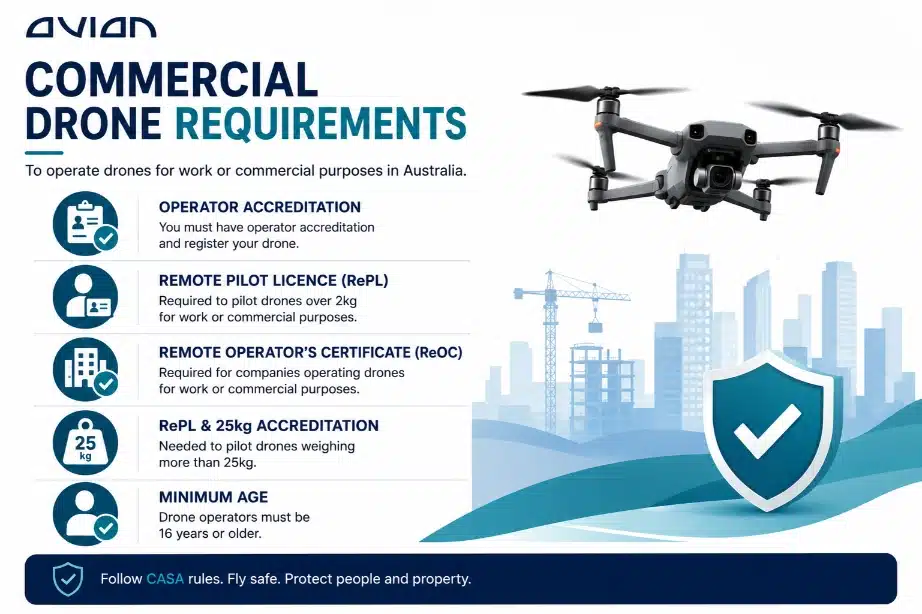
CASA has specific rules for commercial drone operations such as:
- A drone operator accreditation and valid registration to fly a drone in Australia for commercial purposes.
- A remote pilot licence (RePL) for individuals using drones weighing more than 2kg for work and commercial purposes.
- A remote operator’s certificate (ReOC) for companies using drones for work and commercial purposes.
- A remote pilot licence and 25kg accreditation to fly a drone weighing more than 25kg.
- The drone operator must be 16 years or older to register a drone and apply for accreditation.
CASA drone rules in Victoria
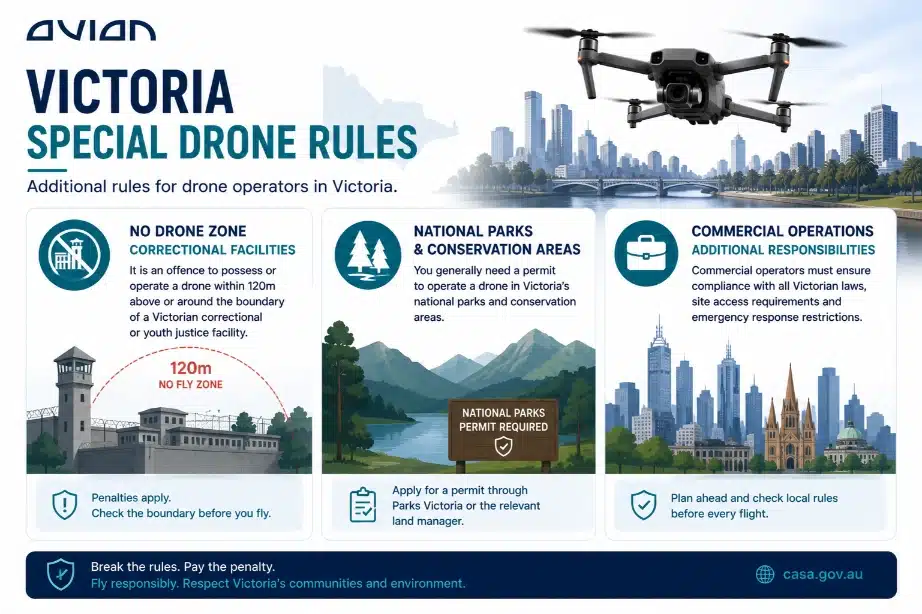
A 2018 update about CASA drone laws in Melbourne states that drone operators cannot fly their UAVs near correctional facilities and youth justice facilities. These rules remain in force. From 1 February 2018, it became an offence to possess or operate a drone within 120 metres above or around the boundary of a Victorian correctional facility or youth justice facility.
These regulations state:
- It is an offence to fly drones within 120m above/around correctional facilities.
- Drones must always be 30m away from people and vehicles.
- Drones cannot fly within a 5.5km range of controlled airfields.
These regulations will not punish accidental or unintentional behaviour. This law only applies to deliberate, reckless drone activity near correctional facilities, and a maximum of two years imprisonment can apply to serious breaches.
It’s also worth noting that recreational drone use is prohibited in all state parks, national parks and reserves across Victoria. Commercial operators with the appropriate ReOC can apply for permits to fly in these areas.
CASA over 250g drone rules
Drone pilots who want to fly drones that weigh over 250g for recreational purposes must follow the standard CASA drone rules. There is no age limit to fly a drone for fun, and recreational pilots do not need a licence or operator accreditation. Recreational pilots also do not need to register their drone when flying for fun.
For commercial operations, pilots flying drones over 250g must become accredited with CASA. For small commercial operators, an RPA Operator Accreditation is available as a free online course and quiz, required for flying drones under 2kg for work purposes if the pilot does not hold a RePL. This accreditation is valid for three years and covers basic airspace rules, safety practices, and legal obligations. You can complete it online through the myCASA portal.
You can also fly drones that weigh between 2 and 25kg over your personal property without a RePL, provided you are the landowner or leaseholder, you own the drone, register it with CASA, complete the RPA operator accreditation, and do not accept any payment for flying.
New CASA drone rules (2025–2026 updates)
All commercial drones must be registered, and operators must hold valid accreditation. The original mandatory registration deadline was 28 January 2021, and these obligations remain in force. These regulations apply to all commercial drones, irrespective of their weight.
Several significant regulatory changes have occurred since 2022, and more are underway:
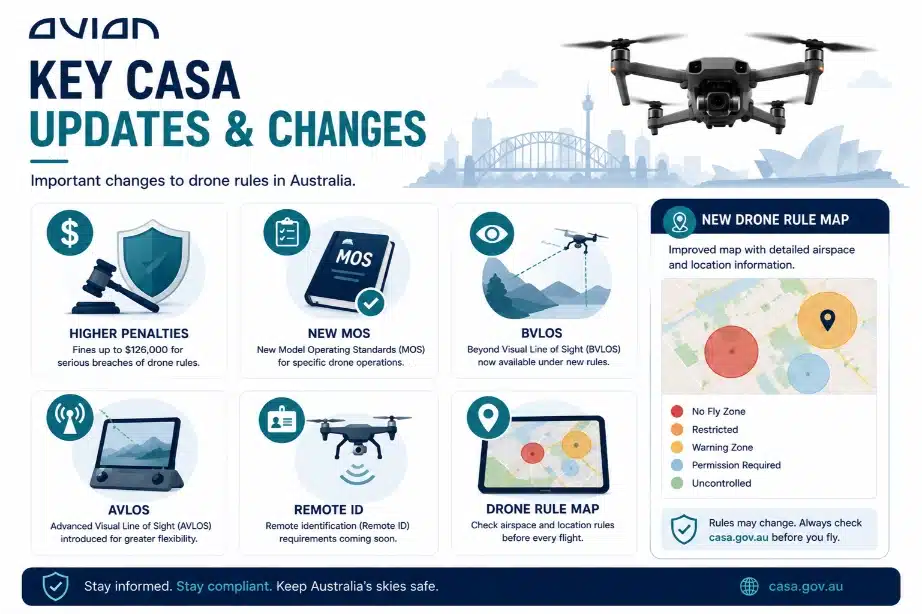
Updated fine structure
CASA officers can now issue infringement notices of up to $1,650 per offence on-the-spot. If the matter proceeds to court, fines can reach $16,500 per offence. Flying an unregistered drone for business purposes can attract a higher court-imposed penalty. Serious or repeated breaches can also result in the loss of commercial operating privileges.
New Manual of Standards (MOS) – January 2025
A new Manual of Standards for RePL training providers took effect in January 2025, changing training requirements for accredited providers. Operators seeking a RePL should ensure their training provider is certified to the current 2025 MOS standard.
BVLOS trial pathways – October 2025
From 15 October 2025, CASA launched four new broad-area BVLOS (Beyond Visual Line of Sight) approval pathways under Temporary Management Instruction TMI 2025-03, making advanced drone approvals more accessible for commercial operators. This is a significant development for survey, infrastructure inspection, and agriculture operators who require extended range operations.
Assisted visual line-of-sight (AVLOS) trial – 2026
CASA’s trial allowing RePL holders to use spotters for FPV-style operations (AVLOS) has been delayed to 2026 and is currently in development.
Simplified approvals for flights over people
CASA has updated an exemption for approved operators flying drones over areas where lots of people are present. Operators and pilots previously approved to fly close to people or within another person’s safety zone may not need a separate approval for flights over some populous areas under the new measure. The exemption applies to very small, small and medium remotely piloted aircraft.
Remote ID – on the horizon
Remote ID – a system that broadcasts a drone’s identification and position to authorities and other receivers – is already mandatory in the United States and is being rolled out across Europe. Australia is tracking these developments, and CASA has signalled that Remote ID requirements are coming domestically. As of mid-2025, specific timelines for mandatory implementation were still under consultation. If you’re purchasing a new drone now, choosing a model with Remote ID capability built in is a sensible step.
National drone rule map
The Australian Government has launched a national drone rule map at drones.gov.au, showing local drone rules for parks and corrections institutions across Australia. The first release covers rules for 7,610 different areas managed by 15 different responsible authorities. This is a useful planning tool alongside the CASA OpenSky app for checking restricted zones before flight.
Commercial drone activities covered by registration requirements include:
- Land surveys, property, asset and building inspections.
- Recording construction sites, capturing photos/video as part of your work.
- Using drone footage for commercial purposes.
- LiDAR drone surveying and mapping.
- Monitoring, surveillance or security services.
Aerial Asset Inspection Costing Guide
Learn about our approach to Asset and Building Inspections
What’s driving ongoing regulatory change?
Drones have become a popular surveying tool in Australia over the past decade. Landowners, property developers, engineers, builders, and more turn to drone surveying services for a quick and cost-effective view of the project, site surveillance and construction site mapping.
Australia’s drone industry has grown remarkably. As of May 2025, 38,874 licensed drone operators were registered – a number that now exceeds the 30,845 conventional crewed pilots in Australia. This explosive growth is exactly why CASA continues to refine its regulatory framework.
Drones help AEC professionals gather better results than manual on-the-ground site inspections. However, flying drones over a construction site comes with its fair share of risks.
Drone crashes and on-site injuries are more common than you’d think – we’re constantly being told of clients who have had a drone crash on site. Luckily, most times it’s not serious, but these occurrences are increasing, and it’s only a matter of time before a more serious incident occurs.
This is why it’s important to follow the drone operation regulations set by CASA. Registration ensures better on-site safety and prevents accidents, plus any relevant insurance coverage is valid as all relevant CASA rules and regulations were followed.
Drone registration also makes it easier for CASA to identify the UAV in case the device is misused, lost or involved in illegal activities.
According to the recent drone data protection laws in Australia, you cannot take unsolicited pictures of people or private properties without the owner’s explicit consent. The individual is well within their rights to demand access to such recordings or potentially file a lawsuit for damages.
Drone registration
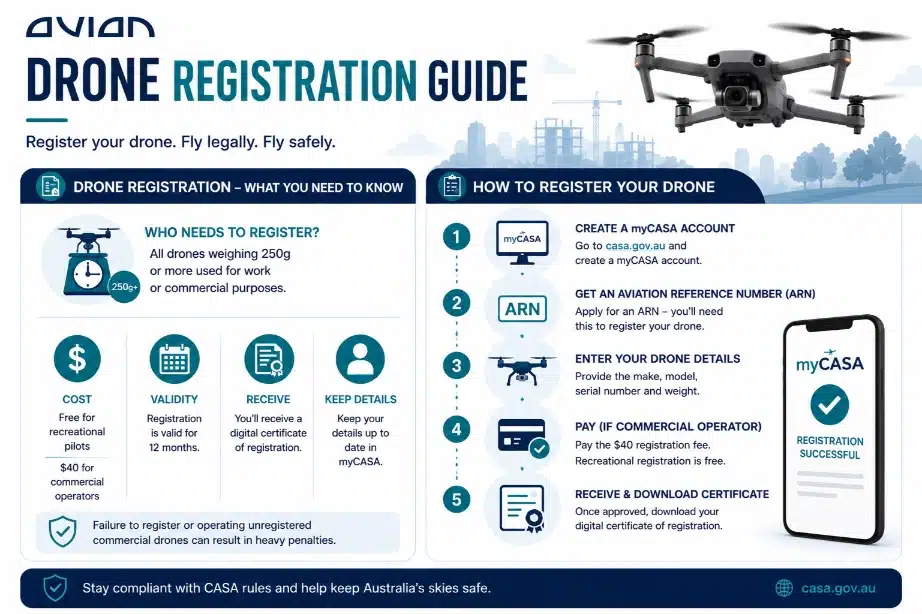
Drone pilots who want to fly drones for business or as part of their job are required to register with CASA. This applies to all drones used commercially, regardless of their weight, and is completed through CASA’s online myCASA portal. Registration is valid for 12 months, and the individual or company registering the drone must be at least 16 years old.
Commercial drone activities that require registration include:
- Selling photos or videos taken from a drone.
- Inspecting industrial equipment, construction sites or infrastructure.
- Monitoring, surveillance or security services.
- Research and development.
- Any drone activities on behalf of your employer or business.
There is an annual registration levy of AUD $40 for commercial drones weighing more than 500 grams, while drones weighing 500 grams or less are exempt from this fee, making their registration free.
When is drone registration not mandatory?
You do not need to register a drone if:
- You are flying drones for recreational purposes only (no payment, sponsorship or commercial arrangement of any kind).
- You do not intend to fly it.
- You are a commercial drone manufacturer or repairer.
CASA had planned to introduce mandatory registration for recreational drones over 250g in 2023, but this initiative was paused by the Australian Government. Hobbyist pilots can therefore fly without registering their aircraft, provided it’s only for sport or recreation.
How to register drones under CASA?
Follow these steps to register a drone online with CASA.
- Go to MyCASA portal
- Create a MyCASA account
- Provide your proof of identify
- Enter ARN (aviation reference number)
- Enter the drone details such as model, serial number, weight, etc.
If you are a part of a company, or if you offer drone services in Melbourne or Australia-wide you can register the drone under the company’s ARN number. This helps employees at the organisation to access and use the drone.
Remember: you need to be 16 years or older to register a drone.
Once the registration process is complete, you can download the certificate and take a printout to carry with you.
CASA and major airports have detection devices to locate unregistered drones. If you fly an unregistered drone for business or your job, you could face a fine of up to $16,500.
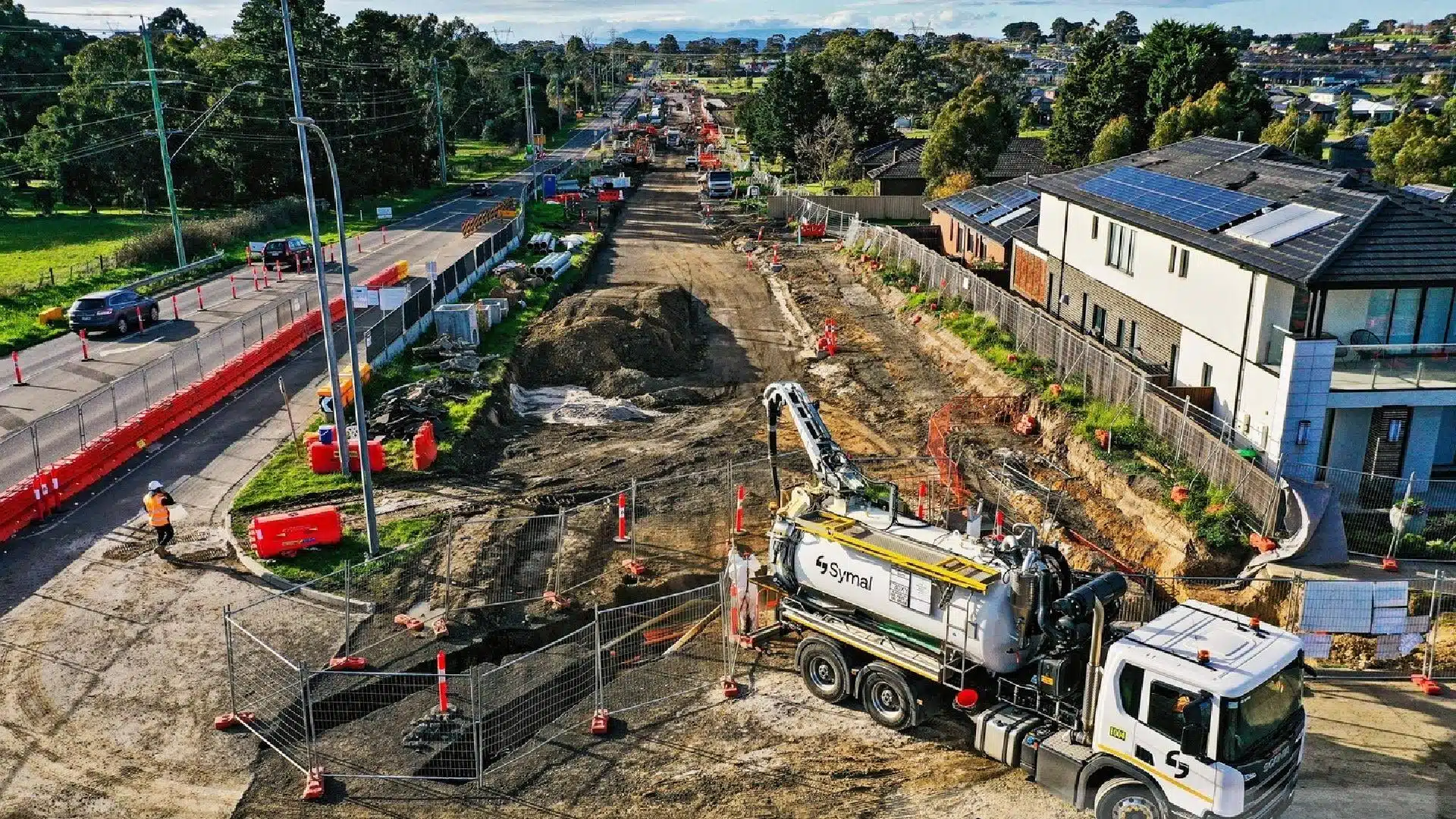
The future of drones in Australia
Drones have become an indispensable asset to the Australian AEC industry. UAVs allow engineers, project managers and surveyors to capture clear site information, save time, prevent accidents, and reduce workload or duplication of effort.
Australia’s drone market is on a strong growth trajectory, with the global drone market valued at USD $73.06 billion in 2024 and expected to grow at a CAGR of 14.3%, reaching USD $260 billion by 2030. Advances in battery energy density, sensor miniaturisation, and onboard data-processing technologies are driving much of that growth.
I always advise drone pilots and operators to ensure they have adequate commercial drone insurance. There are two types of drone insurance you can choose from:
- Public Liability Insurance: covers third-party damages caused by the drone. This would include property destruction, crashes or injuries caused by drones, etc.
- Hull Insurance: covers the repair or replacement cost for damage to the drone/s during a crash or accident. This includes damage to the drone body, camera, and other drone equipment and accessories.
The Bottom Line
If you’re planning to use drones for commercial inspections—such as building assessments, infrastructure monitoring or industrial surveys—it’s essential to ensure your drone complies with CASA’s safety and operational requirements. For businesses aiming to stay compliant while maximising performance, here’s a comprehensive list of inspection drones commonly used across Australia. These models are not only reliable and feature-rich, but also widely recognised in regulated commercial operations.
At Avian, we are always up-to-date with the latest drone developments and CASA regulations. Our team of operators, geospatial experts and land surveyors aid clients not just with surveying and laser scanning but also with related services.
Check out this space for more updates on CASA drone laws in Victoria. Or you can always contact us to book a free consultation with us! Our team will get back to you ASAP with convenient time to discuss your project so we can develop a custom solution for you.